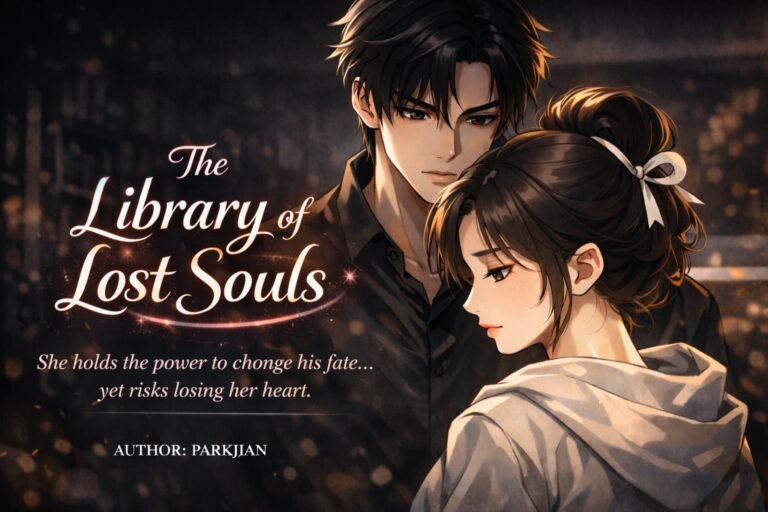
Story/Novel Title: The Library of Lost Souls
Genre: Fantasy Romance / Mystery
Author: PARK JIAN (ME)
CHAPTER
SIX
What the Library Takes
Firasha didn’t remember running the whole way back to Larkin Street, but her lungs burned like she had, and the wooden bird was still clutched so tight in her fist that its wings had left small red marks pressed into her palm.
The gap in the wall was already open, waiting, like it had known she would come back before she did.
“Wren!” Her voice cracked against the shelves, swallowed almost instantly by the endless rows of books. “Wren, I need to talk to you!”
Silence answered her first. Then, from somewhere deep in the stacks, unhurried footsteps, the soft jingle of keys at a hip, and Wren appeared at the end of an aisle with an expression that suggested she’d been expecting this exact moment for longer than Firasha had been alive.
“Ten days,” Wren said, before Firasha could get a word out. “He told you.”
“You knew.”
“I knew someone would, eventually. I didn’t expect Thorne to be the one, but I suppose it makes a strange kind of sense.” Wren set down the book she’d been carrying on a nearby table, folding her hands, patient as always, though something behind her grey eyes looked tired in a way Firasha hadn’t noticed before. “Sit down. If you’re going to yell at me, you might as well be comfortable while you do it.”
“I don’t want to sit.” Firasha’s voice shook, half fury, half fear. “I want you to tell me how to save him. All of it. No more warnings, no more half-answers. You said nothing gets rewritten for free. Fine. Tell me the price. Tell me exactly what it is, so I can decide.”
Wren studied her for a long moment, the kind of look that felt like being turned over and examined for cracks.
“Sit down anyway,” she said. “This isn’t a short conversation, and you’re about to need your strength for it.”
Firasha sat, reluctantly, perched on the edge of a worn wooden chair like she might need to bolt at any second.
“The books in this library aren’t just records,” Wren began, lowering herself into the chair across from her with the careful precision of someone whose joints remembered every year they’d lived, even if her face didn’t show them. “They’re tethers. Every person’s story is written in real time, page by page, as they live it — and the ink that writes those pages doesn’t come from nowhere. It comes from them. Their choices. Their memories. Their moments that mattered enough to leave a mark.”
“So when a book runs out of pages—”
“It means that person’s had every choice, every memory worth keeping, already spent.” Wren’s voice stayed level, clinical, the tone of someone who had explained this so many times it no longer had the power to unsteady her — or who had trained herself not to let it. “That’s simply how a life ends. Not a punishment. Just… arithmetic.”
“Then how does anyone ever add pages?”
“They don’t. Not out of nothing.” Wren met her eyes directly now, and something in her posture went very still, very deliberate. “If you want to give Javiar more pages, you have to write them yourself. And ink like that only comes from one place.”
Firasha’s stomach dropped before Wren even finished the sentence. “My own book.”
“Your own book,” Wren confirmed quietly. “Your own memories. You give him pages, you’re not creating anything new — you’re transferring what’s already yours. A day for a day. A memory for a memory. Sometimes, if the story’s stubborn enough, more than that.”
The room felt suddenly colder. Firasha wrapped her arms around herself without meaning to. “What happens to the memory? Does it just… disappear?”
“Not disappear.” Wren’s jaw tightened almost imperceptibly. “Transfer. It becomes his. He’ll live it, somewhere in the part of his mind that already holds his own past, as if it always belonged there. You, on the other hand—” She paused, like even after however many years of saying this to however many people, the next words still cost her something. “You’ll simply stop having it. Not a blank space where it used to be. Just… nothing. As if it never happened to you at all.”
“That’s insane.” Firasha’s voice came out thinner than she wanted it to. “You’re telling me I could forget my own mother to save him.”
“I’m telling you that you could forget anything.” Wren’s tone sharpened, not unkind, but urgent, like she needed this part to land harder than the rest. “The book doesn’t ask permission for which memory it takes. You don’t get to choose a boring Tuesday you don’t care about. It takes whatever holds the most weight, because weight is what makes good ink. The heavier the memory, the more pages it buys him.”
Firasha sat with that for a long, silent moment, staring down at her own hands like she might find the answer written somewhere across her palms.
“You’ve done this before,” she said finally. Not a question.
Something in Wren’s carefully composed face cracked, just slightly, just long enough for Firasha to see straight through it.
“Once,” Wren admitted, and her voice, for the first time all night, lost its steady edge. “A long time ago. Someone I loved very much had run out of pages faster than he should have. I did exactly what you’re considering. I gave him mine.”
“Did it work?”
“He lived.” Wren’s hands, folded neatly in her lap, tightened until her knuckles paled. “For eleven more years. Good years, from what I understand. He got to grow old. He got to have a whole life he wasn’t supposed to have.”
“Then why do you sound like it went wrong?”
Wren was quiet for a long moment, staring at some point past Firasha’s shoulder, somewhere in the shelves that held every story that had ever ended.
“Because the memory the book took from me,” she said finally, “was every single memory I had of loving him. Every conversation. Every reason I’d fallen for him in the first place. I gave him eleven more years of life, and in exchange, I forgot I had ever wanted him to have them.” She let out a breath that wasn’t quite steady. “I watched him grow old from a distance, for eleven years, without the faintest idea why some stranger kept showing up at the edges of his life, or why it hurt so much every time I saw him and couldn’t remember why.”
Firasha’s chest ached with a grief that wasn’t hers, borrowed secondhand from a story she was only just hearing. “Wren, I’m so sorry.”
“Don’t be.” Wren straightened, visibly pulling herself back together, folding the rawness away like she’d had decades of practice doing exactly that. “I’m telling you this so you understand precisely what you’re offering, not so you’ll feel sorry for me. The library doesn’t deal in half-measures. If you do this, you will lose something that matters, and you will not get to choose what it is, and you will very likely lose the ability to remember why you’re grieving it in the first place.”
“Then how is that saving anyone?” Firasha’s voice cracked. “If I forget why I loved him, what’s even left of me to love him with?”
“That,” Wren said quietly, “is the question every single person who’s ever sat in that chair has asked me. I don’t have a comforting answer. I only have the true one.” She reached into the folds of her coat and withdrew a single blank page, old parchment, slightly yellowed at the edges, and set it gently on the table between them. “If you want to try, this is where it starts. One page. See how much it costs you before you decide whether you can afford the rest.”
Firasha stared at the page like it might bite her. “Just one page? That’s it? What’s this even for?”
“A single day. One extra day for him, taken from whatever memory the book decides is heaviest inside you tonight.” Wren’s grey eyes held hers, steady and unflinching, carrying none of the softness from a moment ago. “Small enough that you’ll survive losing it. Large enough that you’ll understand exactly what you’re agreeing to before you go any further.”
Firasha reached out, fingers hovering just above the parchment, close enough to feel that same static hum crawling up her skin, the same pull she’d felt the very first night she stepped through the wall on Larkin Street.
“If I do this,” she said quietly, more to herself than to Wren, “there’s no taking it back. Is there.”
“No,” Wren said. “There never is. That’s the part nobody wants to hear, and it’s the part I need you to hear the most.”
Firasha’s hand hovered there, trembling slightly, ten days and one single page away from a choice she couldn’t undo — and somewhere behind her ribs, a small, terrified voice asked whether she was about to save the boy she was falling for, or quietly begin disappearing from her own life instead.
Would she press her palm to the page — or would fear finally be louder than love?
CHARACTER PROFILE — Introducing This Chapter
Rhea Voss | Javiar’s Childhood Best Friend
Basic Information
| Field | Detail |
|---|---|
| Full Name | Rhea Voss |
| Nickname | Ray |
| Age | 20 |
| Date of Birth | July 15th |
| Pronouns | She/Her |
| Sexuality | Straight |
| Nationality | Ashwickian |
Appearance
| Field | Detail |
|---|---|
| Hair Colour | Auburn, wavy, almost always in a high ponytail |
| Eye Colour | Green |
| Height | 5’6″ |
| Weight | Athletic build |
| Distinguishing Features | Small silver stud in her nose, freckles across her cheeks, a stack of mismatched bracelets that jingle when she talks with her hands |
Personality
| Field | Detail |
|---|---|
| Introvert or Extrovert | Extrovert, blunt, says what everyone else is thinking |
| Best Traits | Loyal, protective, brave enough to confront anyone for the people she loves |
| Worst Traits | Jumps to conclusions fast, holds grudges, slow to trust new people |
| MBTI Type | ESTP |
The Girl He Won’t Stop Talking About
Firasha pressed her palm flat against the page.
The parchment burned cold under her skin, then hot, then cold again, and ink bloomed across it on its own, curling into words she hadn’t written. Wren stood back, watching, silent.
“It’s done,” Wren said quietly. “What did it take?”
Firasha reached for the memory instinctively — her twelfth birthday, the one before everything changed, the one with the lopsided cake her mother had insisted on making herself.
Nothing came.
“I can’t—” Her voice cracked. “There was a birthday. I know there was one. I can’t see it.”
“That’s the price.” Wren’s face didn’t change, but her voice had gone gentle. “I’m sorry.”
Firasha pressed a hand to her mouth, blinking hard. “It’s just one day. He gets one more day.”
“One day,” Wren agreed. “Was it worth it?”
Firasha didn’t answer. She didn’t know yet.
⁂
Javiar woke up that morning feeling strange in a way he couldn’t explain — lighter, somehow, like he’d slept off a fever he didn’t remember having.
“You look weird,” Rhea said, dropping onto the stool across from his workbench without asking. “Weird good, not weird bad. What happened to you?”
“Nothing happened to me.”
“Liar.” She stole a piece of sandpaper off his bench and started fiddling with it, not because she needed it, but because her hands never stopped moving. “You’ve had that face for three days now. The one where you’re smiling at nothing.”
“I don’t have a face.”
“You have a face, Jav. Everyone has a face. Yours currently says ‘I met a girl and I haven’t told my best friend yet,’ which, frankly, is rude.”
Javiar laughed, caught. “Her name’s Firasha.”
“Firasha.” Rhea repeated it slowly, testing it, eyes narrowing. “Weird name.”
“Says the girl named after a river god.”
“That’s different, that’s a family thing.” She leaned forward, bracelets clinking. “Tell me everything. Where’d you meet her?”
“That library. The one nobody talks about.”
Rhea went very still. “The one on Larkin Street?”
“Yeah. Why?”
“No reason.” She stood up too fast, tossing the sandpaper back onto the bench. “Just — be careful with that place, okay?”
“Careful how?”
“I don’t know.” Her jaw tightened. “My grandma used to say things about it before she died. Weird things. I never told you because it sounded insane.” She looked at him hard, all the teasing gone out of her voice. “Just don’t fall for this girl before you know what she’s not telling you.”
⁂
Firasha found Javiar outside the shop that evening, locking up, keys jingling in his hand.
“Hey.” He looked up, and whatever tension had been sitting in his shoulders melted the second he saw her. “I was hoping you’d show up.”
“Rough day?”
“Rhea interrogated me for twenty minutes about you. So, yes.” He grinned, tucking the keys away. “You free? I was about to get dinner. Terrible dinner. The kind you eat standing at a food truck because you’re too tired to sit down properly.”
“That sounds perfect, actually.”
They walked two blocks in comfortable quiet before he spoke again.
“Can I ask you something?” he said. “And you don’t have to answer.”
“Okay.”
“What are you so scared of?” He wasn’t smiling anymore. “Every time we talk, there’s this second where you look at me like you’re about to say something huge, and then you don’t. I’m not trying to push. I just — I notice.”
Firasha stopped walking.
“I’m scared,” she said slowly, “that if I tell you the truth, you’ll either think I’m insane, or you’ll believe me, and everything gets so much harder after that.”
“Try me.”
“Not yet.” Her voice shook. “Please. Not yet.”
He studied her for a long moment, then nodded, some quiet trust settling into his expression that she hadn’t earned and didn’t deserve. “Okay. Not yet.”
He held out his hand, not asking for anything, just offering. She took it.
Walking beside him, his hand warm around hers, she understood — clearly, suddenly, like a light switching on in a dark room — that this wasn’t just fear of losing him anymore.
Somewhere between the wooden bird and this exact moment, she’d fallen in love with him.
⁂
Two streets over, Callix Thorne stood in the doorway of a shuttered bookshop, watching them go.
“She already gave up a memory,” a voice said beside him. Wren, arms crossed, unreadable as ever. “One page. One day.”
“She’ll keep going,” Callix said. “They always do, once they start.”
“You did.”
“I did.” He didn’t look at her. “You want me to stop her?”
“No.” Wren’s voice was quiet. “I want you to make sure she understands what she’s spending, before there’s nothing left of her to spend it with.”
Callix finally turned to face her, something unreadable passing between them — history neither of them said out loud.
“And if she runs out before he does?” he asked. “What then?”
Wren didn’t answer.
She didn’t have to. They both already knew.
Seven Days Left
Rhea found Firasha first.
Not by accident.
She was waiting outside the coffee shop on Mercer Street, arms crossed, auburn ponytail swinging in the wind, green eyes fixed on Firasha like she’d been rehearsing this conversation since yesterday.
“Sit with me,” Rhea said. Not a question.
“I don’t—”
“It wasn’t a request.” She pulled open the door, held it, and waited.
Firasha sat.
They ordered nothing. Rhea put both hands flat on the table and leaned forward.
“How do you know about that library?”
“Javiar told me about it.”
“No.” Rhea’s jaw tightened. “You knew about it before he said anything. I could see it on your face the second he mentioned it. Don’t lie to me, I’m very hard to lie to.”
Firasha said nothing.
“My grandmother,” Rhea said, dropping her voice, “used to tell me this story when I was small. She said there was a hidden library in this city where every dead person had a book. She said her mother had gone inside once and come back different. Quieter. Like something had been taken out of her.” She paused, watching Firasha carefully. “I thought it was just a story. Until Jav mentioned Larkin Street.”
“Rhea—”
“Is he in danger?”
Firasha’s silence was answer enough.
Rhea sat back hard, like something had knocked the air out of her. “How bad?”
“I’m handling it.”
“That’s not what I asked.” Her voice cracked, just slightly, and underneath the sharp edges, Firasha saw it — real, raw fear, the kind that only lives in people who love someone deeply enough to be terrified of losing them. “He’s my best friend. He has been since we were seven years old. If something is happening to him, I need to know.”
“If I tell you,” Firasha said carefully, “you can’t tell him. Not yet.”
“Why not?”
“Because knowing would change the way he lives every day he has left, and he deserves to just — live them. Without watching the clock every second.” Her voice went quieter. “Please.”
Rhea stared at her for a long moment, something shifting behind her eyes, the suspicion softening into something more complicated.
“You care about him,” Rhea said slowly, like she was figuring it out as she said it.
“Yes.”
“How much?”
Firasha looked down at the table. “More than I expected to.”
Rhea was quiet for a moment. Then — “Okay. Tell me everything.”
⁂
It took an hour. Firasha told her almost all of it — the library, the books, Wren, the pages running out. She left out the part about trading her own memories, because that part was hers to carry, and she wasn’t ready to put it down in front of anyone else yet.
When she finished, Rhea sat very still, both hands wrapped around a coffee cup she’d finally ordered halfway through and hadn’t drunk a single sip of.
“Ten days,” Rhea said flatly. “He had ten days.”
“Seven now.”
“Seven.” Rhea pressed her lips together hard. “Okay. What do you need from me?”
Firasha blinked. “I thought you’d argue.”
“I’m saving it for later.” Rhea’s voice was steady now, firm, the sharpness back but pointed in a different direction. “Right now I need to know what I can do, so tell me.”
“Keep him busy,” Firasha said. “Keep things normal. If he notices something’s wrong with me, tell him I’m fine. And—” She hesitated. “Don’t let him come back to the library. Not until I figure out how to fix this.”
Rhea nodded once, short and decisive.
Then she reached across the table and put her hand over Firasha’s wrist, bracelets clinking.
“For what it’s worth,” Rhea said quietly, “he talks about you constantly. Like, embarrassingly constantly. I’ve known him for thirteen years and I’ve never heard him say anyone’s name the way he says yours.”
Firasha’s chest hurt. “Don’t tell me things like that right now.”
“Too bad. You need to hear it.” Rhea let go, picked up her coffee, finally took a sip, and made a face. “This is terrible. Why did I order this?”
⁂
Javiar was waiting for Firasha outside her building when she got home, sitting on the front steps with his knees up and his sketchbook open on his lap, drawing something she couldn’t see yet.
“How did you know where I live?”
“You mentioned the building once. The one with the blue door.” He looked up, completely unbothered by the fact that this was at least slightly alarming. “I brought food. Actual food, not food truck food. I felt guilty about yesterday.”
“You don’t need to feel guilty.”
“I know. I did it anyway.” He held up a paper bag. “Dumplings. Best in the city, according to a very loud woman at the market who wouldn’t let me leave until I agreed.”
Firasha laughed before she could stop herself, and the knot in her chest loosened, just slightly.
They sat on the steps together, passing the dumplings back and forth, shoulders touching, the evening settling cold and soft around them.
“What are you drawing?” she asked.
He turned the sketchbook toward her.
It was her. Or — not quite her, more like the feeling of her, a girl standing in a library with her hand just above a shelf of books, not quite touching, light falling around her like she was the reason it was there.
Firasha stared at it for a long time without saying anything.
“Too weird?” he said. “I can rip it out.”
“Don’t you dare.” Her voice came out softer than she meant it to. “It’s beautiful.”
“Yeah.” He was looking at her, not the drawing. “It is.”
The air between them shifted, the way it always did right before something true got said. Firasha felt his shoulder warm against hers, felt the exact second his breathing changed — slower, more careful — and she turned her head and he was already looking at her, closer than she’d expected, close enough that she could see the small scar on his chin she hadn’t noticed before.
“Firasha,” he said quietly.
“Don’t.” Her voice came out barely above a whisper. Not because she didn’t want him to. Because she was terrified of how much she did.
“Okay,” he said, just as quietly. He didn’t move away. Neither did she.
They sat like that for a long time, the space between them full of everything neither of them said, which somehow felt more real than anything they could have.
⁂
Later that night, Callix found her on the walk home.
He fell into step beside her without announcement, coat collar up, hands in his pockets, like they did this all the time.
“You told the friend,” he said.
“She needed to know.”
“That’s a risk.”
“So is doing nothing.” Firasha kept walking, eyes forward. “How many memories have I got left before he’s safe?”
Callix was quiet for three steps. “At the rate the book is filling — four more. Maybe five.”
“Four memories.”
“Heavy ones. The book doesn’t take small things, Firasha, you know that by now.”
She did know. She just hadn’t wanted to count it out loud yet.
“And if I run out,” she said. “If I give everything I have and it’s still not enough?”
“Then we find another way.”
“Is there another way?”
Callix didn’t answer.
She stopped walking and looked at him directly. “Callix. Is there another way?”
He met her eyes, and what she saw there wasn’t reassurance. It wasn’t cruelty either. It was just honesty, the tired kind, the kind that had stopped trying to soften itself.
“There might be,” he said. “But you’re not going to like it.”
“Tell me anyway.”
He looked away, jaw tight, something working itself out behind his expression.
“The library has a last page,” he said. “Every book does. But the library itself — the whole place, the entire Archive — has one too. A master page. If someone writes on it, they don’t buy a day or a memory. They rewrite the rule. Permanently.” He paused. “Anyone’s story can be changed. No cost. No trade. Just — fixed.”
Firasha stared. “Then why hasn’t anyone used it?”
“Because the last person who tried,” Callix said flatly, “disappeared.”
The street felt suddenly very quiet.
“Disappeared how?” she asked.
“Gone. Not dead — I checked. Just gone. Like the library kept them instead of the page.” His voice dropped. “I think the library takes a keeper in exchange. Someone to stay behind and hold the Archive together so everyone else’s stories keep running.”
Firasha’s blood ran cold.
“You’ve known about this the whole time.”
“Yes.”
“And you didn’t tell me.”
“I’m telling you now.”
She stared at him in the dark, rain just beginning to fall again, soft and cold, and understood that this was what he’d meant in Chapter 5 when he’d said she wouldn’t like it.
He was right. She didn’t.
But she was already thinking about it — already turning it over, already asking herself the question she didn’t want to answer.
If the only way to save Javiar was to give herself to the library forever, would love be enough reason to do it?