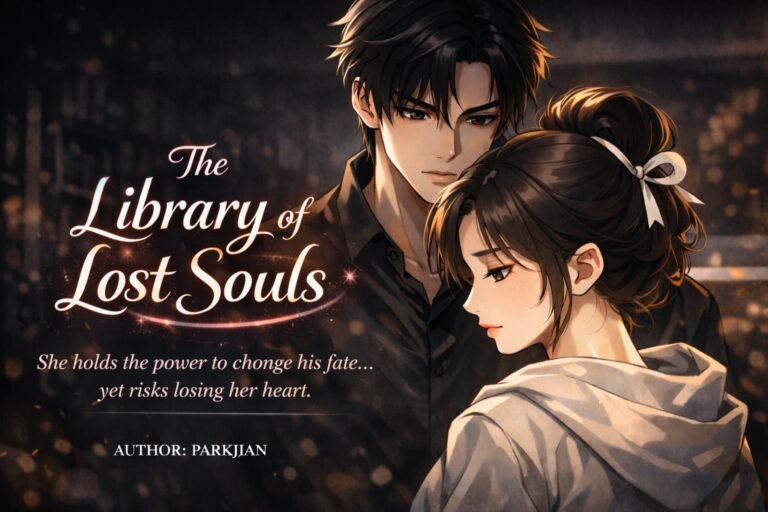
Story/Novel Title: The Library of Lost Souls
Genre: Fantasy Romance / Mystery
Author: PARK JIAN (ME)
CHAPTER
SEVEN
Six Days, One Truth
“You look terrible.”
Firasha looked up from the library table. Wren was standing over her with a cup of something hot, expression unreadable as always.
“Thank you, Wren.”
“It wasn’t an insult. It was an observation.” She set the cup down. “You haven’t slept.”
“I’ve been thinking.”
“About the master page.”
Firasha’s head snapped up. “You knew.”
“I’ve known since the day it was discovered.” Wren pulled out the chair across from her and sat, hands folded, voice flat. “Callix had no right to tell you.”
“He had every right. It’s Javiar’s life.”
“It’s your life too.” Wren’s grey eyes sharpened. “That page has taken one person already. I watched it happen. I watched someone walk up to that shelf in the back of this library, press their hand to the last page, and simply — stop existing. Not die. Not leave. Just stop.” She leaned forward. “You are not doing that.”
“You don’t get to decide that.”
“No.” Wren’s voice dropped. “But I get to make sure you understand what you’re deciding.”
Firasha wrapped both hands around the cup. “Did it work? The person who disappeared — did their story get fixed?”
Wren was quiet for a long moment.
“Yes,” she said finally.
“Then it worked.”
“Firasha—”
“It worked, Wren.” Her voice cracked. “That’s not nothing. That person saved someone. That’s not a bad ending.”
Wren looked at her for a long, heavy moment, something moving behind her composed face that looked almost like grief.
“No,” she said softly. “It’s not a bad ending. It’s just a very lonely one.”
⁂
Rhea called at noon.
“He’s asking about you.”
Firasha pressed the phone harder against her ear. “What did you say?”
“That you were busy. That you’d see him tonight.” A pause. “He made you something.”
“What?”
“I don’t know, he won’t show me. He’s been in the shop since six this morning and he told me to leave twice, which he never does.” Rhea’s voice dipped. “Firasha. How many days?”
“Six.”
A sharp exhale. “Six. Okay. Are you—”
“I’m fine.”
“Stop saying that.”
“I’m handling it.”
“That’s somehow worse.” Rhea’s voice cracked, just slightly, before she pulled it back. “He was humming this morning. While he worked. He never hums. I just — I want you to know that. Whatever you’re doing, whatever it’s costing you, it’s working. He feels it somehow. He feels better.”
Firasha closed her eyes.
“Keep him busy today,” she said. “I’ll be there tonight.”
⁂
She went to the library first.
Deep in the back shelves, past rows of lives she’d stopped looking at because every cover now felt too personal, too heavy — she found it.
The master page.
It wasn’t dramatic. That was the thing that surprised her. She’d expected something massive, something that announced itself. Instead, it was a single loose page sitting in a plain wooden frame on the lowest shelf, slightly yellowed, completely blank.
Completely ordinary.
She stood in front of it for a long time with her hands at her sides.
“It won’t bite,” Callix said from behind her.
She didn’t turn around. “You followed me.”
“I followed you here to talk you out of it.” He stepped up beside her, both of them staring at the page. “I’ve been standing in front of this thing for ten years, Firasha. Running the numbers. Trying to find a loophole, another way, something I missed.” He paused. “I never found one.”
“Because there isn’t one.”
“Because there isn’t one,” he agreed quietly.
She finally looked at him. Up close, in the candlelight of the back shelves, he looked older than she usually thought of him — not in age, but in something else, the way a person looks when they’ve been carrying something too long.
“The person who disappeared,” she said carefully. “Ten years ago. The one whose story got fixed.” She watched his face. “That was her, wasn’t it. The person you loved.”
Callix didn’t move for a long moment.
“She fixed my story,” he said. “I was the one running out of pages, ten years ago. She found my book. She gave up her memories, same as you’ve been doing. And when that wasn’t enough—” He stopped. His jaw tightened. “She walked up to this exact shelf. And I couldn’t stop her in time.”
“Callix.”
“So you understand,” he said, voice low and controlled, “why I cannot stand here and watch someone do this again. Not for him. Not for anyone.”
“You’ve spent ten years warning people away from this page,” Firasha said quietly, “because she used it for you. And you’ve never forgiven yourself.”
He said nothing.
“Callix.” She turned fully toward him. “She saved you. You’re still here. You’ve spent ten years protecting other people because of what she gave you. That’s not a wasted life. That’s not a wasted sacrifice.”
“She’s gone, Firasha.”
“She’s here.” She gestured at the shelves around them. “She’s in every story that didn’t end wrong because of you. That’s not nothing. That’s everything.”
Callix looked away, and for the first time since she’d met him, his composure slipped completely — not dramatically, not loudly. Just a sharp exhale, a hand pressed briefly over his eyes, gone as fast as it came.
“Don’t do this,” he said. “Please.”
“I haven’t decided yet,” she said. And meant it. “I still have six days. I’m not doing anything tonight.”
⁂
Javiar opened the shop door before she could knock.
“I heard your footsteps,” he said. “I recognize them now.”
“That’s slightly alarming.”
“It’s actually very sweet.” He stepped back to let her in, and she saw it immediately — on the workbench, wrapped loosely in cloth, something small.
“What is that?”
“Open it.”
She crossed the room and unwrapped it carefully.
It was a tiny wooden library. Four shelves, dozens of miniature carved books, each one with a letter pressed into the spine. She tilted it closer to the candlelight — he’d carved her initials into the smallest book on the bottom shelf, barely the size of her thumbnail.
“Jav.” Her voice came out barely above a whisper.
“Too much?”
“It’s—” She couldn’t finish the sentence. “When did you make this?”
“Started the night I met you.” He leaned against the bench beside her, arms crossed, watching her face. “Kept adding to it. Couldn’t figure out why until about two days ago.”
“Why two days ago?”
“Because two days ago I figured out that I’m in love with you.” He said it so simply, so directly, no joke underneath it to soften the landing. Just the truth, standing in the open, waiting.
Firasha’s whole chest went quiet.
“Javiar—”
“You don’t have to say it back. I’m not saying it because I need you to.” He looked at her steadily, warm and terrifyingly calm. “I’m saying it because I’ve been carrying it around for a week and it’s heavy, and I think you should know.”
“It’s heavy,” she repeated softly, and almost laughed, because he had no idea how well he’d chosen that word.
“Yeah.” He smiled, small and real. “Heavy good, though. The best kind.”
She set the little library down very carefully, like it was the most important thing she’d ever held, which maybe it was. Then she turned to face him.
“I love you too,” she said. “I have for a while. I just — there are things I haven’t told you yet, and I need you to know that before you—”
“I know.”
She blinked. “What?”
“I know you’re keeping something huge from me.” He uncrossed his arms, stepped closer. “I’ve known since the night we met. I decided it doesn’t change this.” His hand came up, slow and careful, and tucked a piece of hair behind her ear like he’d been wanting to do it for a long time. “When you’re ready to tell me, tell me. I’ll be here.”
For six more days, her mind said, cold and quiet.
Not if I can help it, the rest of her answered back.
She leaned into his hand, just slightly, and closed her eyes, and let herself have this — just this, just right now — without thinking about pages or prices or lonely endings.
“Stay for dinner?” he said softly.
“Yeah,” she whispered. “I’ll stay.”
⁂
Outside the shop window, Rhea stood on the opposite pavement, watching the light inside, arms wrapped around herself against the cold.
Her phone buzzed.
Callix: She’s going to do it.
Rhea stared at the message for a long time.
Then she typed back: Not if we find another way first. How much time do we have?
Callix: Six days. Maybe less.
Rhea looked back through the window — Javiar laughing at something, Firasha smiling in a way Rhea had never seen on anyone’s face before, the kind of smile that only happens when someone is simultaneously the happiest and the most terrified they’ve ever been.
She put her phone in her pocket and made a decision.
She was going back to that library.
And she was going to find something Callix had missed in ten years of looking — because ten years of grief made you blind to things, and she had fresh eyes, and she was not about to let her best friend die and the girl who loved him disappear forever without at least trying.
With six days left on the clock and no plan yet in her hands, would Rhea find the loophole Callix never could — or would Firasha reach that shelf before anyone could stop her?
The Last Page
Rhea had been in the library for six hours when she found it.
Not the master page. Something else.
A small door behind the oldest shelf in the Archive wing, half hidden behind a row of books so thick with dust she’d sneezed four times getting to it. She pushed it open with her shoulder, bracelets jangling, and found a room the size of a closet with one single book inside it.
No name on the cover. Just a symbol she didn’t recognize.
She photographed it on her phone and called Callix.
“I found a room,” she said the second he picked up. “Behind the east shelf. There’s a book in it with no name.”
Silence.
“Callix.”
“Don’t touch it.”
“I already touched it.”
“Rhea—”
“It’s fine, nothing happened. What is it?”
Another silence, longer this time, and when he spoke again his voice had changed completely — lower, stripped of its usual composure. “That’s the Keeper’s Log. Every rule the library has ever made is written in it. Every rule and every — exception.”
Rhea’s heart slammed once, hard. “You didn’t know this existed.”
“No,” he said quietly. “I didn’t.”
She was already opening it.
⁂
Firasha woke up to three missed calls from Rhea and one text that just said: GET TO THE LIBRARY. NOW. BRING NOBODY.
She was out the door in four minutes.
⁂
Rhea was waiting at the entrance, the Keeper’s Log open in her hands, eyes wide, hair half out of its ponytail like she’d been running her hands through it for hours.
“Okay,” she said, the second Firasha walked in. “Okay. Listen to me carefully because I’ve read this three times and I need you to not panic.”
“That sentence always makes me panic.”
“I know. Sorry. Listen.” She held the book out, pointing to a page near the back, ink old and faded but readable. “There is another way. There has always been another way. The master page isn’t the only option — it’s just the option nobody ever found because this room has been locked for a hundred years.”
Firasha grabbed the book. Read the page. Read it again.
“Rhea.” Her voice came out strange. “This says—”
“I know what it says.”
“It says two people can share the cost.”
“I know.”
“Split it between two books instead of one.” Firasha looked up. “If two people both give memories at the same time, the master page doesn’t need a keeper. It just — balances itself. Nobody disappears.”
“Nobody disappears,” Rhea confirmed, and for the first time in days, she was smiling. “You don’t have to do it alone, you idiot. You never did.”
⁂
“Absolutely not.” Wren’s voice was flat as stone. “You are not touching the master page.”
“With two people—” Firasha started.
“I heard what Rhea said.” Wren stood in the center of the Archive wing, arms crossed, grey eyes moving between them both. “I also heard that that room has been locked for a century and neither of you has any idea why.”
“Because nobody knew the exception existed,” Rhea said. “Not because the exception is dangerous.”
“You don’t know that.”
“No,” Rhea said, stepping forward, voice steady. “But I know that Javiar has five days left and Firasha has been giving up her memories one by one and you’ve been watching both of those things happen without offering a single solution. So right now I trust a dusty old book in a locked room more than I trust caution.”
Wren stared at her for a long moment.
Then, slowly, she turned to Firasha. “If this goes wrong—”
“I know,” Firasha said quietly. “I know.”
Wren closed her eyes briefly. “Callix needs to be here. If something happens, someone needs to know how to pull you both back.”
“Call him,” Firasha said. “Please.”
⁂
Callix arrived in twelve minutes, which meant he’d been close.
He walked in, looked at the Keeper’s Log open on the table, looked at Rhea, looked at Wren.
“You found the exception,” he said.
“You knew about the exception?” Rhea stared at him.
“I knew a room existed. I never found a way in.” He looked at her with something that was almost, almost a smile. “You’ve been here six hours and you found it.”
“I’m very determined.”
“Clearly.” He crossed to the table and read the page in silence. Nobody spoke. The candles above them pulsed slowly, the whole library breathing around them.
Finally he looked up. “This could work.”
“Could,” Wren said pointedly.
“Most things could.” He set the book down. “The question is who goes in with her.”
Everyone looked at Rhea.
Rhea looked back at all of them. “Obviously me. Don’t make it weird.”
“You’d lose memories,” Firasha said carefully. “Real ones. Heavy ones.”
“I know.”
“Rhea—”
“Firasha.” Rhea’s voice was firm and soft at the same time, the way it got when she was done arguing and had made up her mind. “He’s my best friend. I’ve known him since we were seven. I watched him teach himself woodworking because it was the only thing that made him feel close to his dad. I watched him stay up three nights in a row when I had my appendix out because he didn’t want me to wake up alone.” Her voice wavered once, then steadied. “If there’s a cost to keeping him alive, I want to pay part of it. That’s not a sacrifice. That’s just — love. The ordinary kind.”
Firasha stared at her.
Then, without saying anything, she crossed the room and hugged her.
Rhea went stiff for exactly one second — surprised — then hugged her back, hard, bracelets clinking against Firasha’s shoulder.
“Okay,” Rhea said into her hair. “Stop that. We have work to do.”
⁂
They stood in front of the master page together, shoulders almost touching.
Callix stood back, one hand raised slightly, ready. Wren stood at the shelf, both hands pressed flat against the wood like she was holding something steady.
“When the ink starts,” Wren said quietly, “don’t let go of each other. Whatever you feel, whatever you lose, don’t pull away. If the connection breaks, the balance breaks.”
Firasha reached over and took Rhea’s hand.
Rhea squeezed back immediately, tight and sure.
“On three?” Rhea said.
“On three,” Firasha agreed.
“One.”
The candles above them went very still.
“Two.”
The library went completely silent — no hum, no breath, nothing.
“Three.”
They both pressed their free hands to the page at the same time.
The cold hit first — sharp and total, like plunging underwater. Then the warmth, rushing in behind it, and then the ink, rising up through the page in long slow curves, writing itself in both directions at once, filling the frame, spilling onto the shelf around it, glowing just slightly at the edges, gold and then white and then simply — light.
Firasha felt it happening, the thing being pulled from her — not a single memory this time but something larger, something she could feel at the edges but not quite see, like a word on the tip of your tongue that keeps slipping away. She held tighter to Rhea’s hand and Rhea held back and neither of them let go.
It lasted maybe thirty seconds.
It felt like an hour.
Then the light faded. The ink settled. The page — for the first time since anyone in that library could remember — was full.
Wren let out a breath. Callix lowered his hand.
Firasha and Rhea stood there, both breathing hard, still holding on.
“What did you lose?” Rhea said finally, voice quiet.
Firasha reached back through herself, carefully, looking for the gap.
“The night I found the library,” she said slowly. “I can remember going home. I can’t remember— I can’t remember how I felt when I first stepped through the wall. That specific feeling.” It ached, the way missing teeth ache, just a small hollow where something used to be. “What about you?”
Rhea was quiet for a moment. Then she made a face. “I forgot why I started collecting these bracelets.” She looked down at her wrist, rattled them gently. “I know I love them. I just — don’t know why anymore.”
“That’s all?”
“That’s all.” Rhea looked up, and despite everything, she was smiling. “Worth it.”
⁂
Javiar called at dawn.
“I feel strange again,” he said. “Like — better strange. Really better. Like I slept a hundred years and woke up with more time than I had yesterday. Does that make sense?”
Firasha stood at her window watching the sun come up, phone warm against her cheek. “Yeah,” she said softly. “It makes sense.”
“Firasha.” His voice changed, went quiet and wondering. “What did you do?”
She closed her eyes. Pressed her hand to the glass.
“Tell you what,” she said. “Come to the shop tonight. Bring Rhea. I’ll explain everything.”
A pause. “Everything?”
“Everything,” she said. “I promise.”
He was quiet for a moment. She could hear him breathing, steady and certain, alive in a way that sat in her chest like sunrise.
“Okay,” he said. “Tonight. But Firasha—”
“Yeah?”
“Whatever you did.” His voice was soft, steady, sure. “Thank you.”
She pressed her lips together hard against the feeling rising in her throat.
“Don’t thank me yet,” she said. “You haven’t heard the whole story.”
“I’ve got time,” he said simply.
She laughed, watery and real. “Yeah.” She wiped her eye with the back of her hand. “You do now.”
⁂
In the library, Wren stood in front of the master page for a long time after everyone had gone.
The page was full. The Archive was balanced. Every book on every shelf held steady.
She pressed one hand flat against the frame, very gently.
“It worked,” she said quietly, to no one, to everyone, to the person she’d forgotten she’d loved a long time ago and still somehow, without the memory to explain it, missed every single day.
The candles above her burned warm and still.
Somewhere on the other side of the city, Callix Thorne stood on a bridge over the river, hands in his pockets, watching the morning come in.
His phone buzzed.
Wren: It worked.
He read it twice. Then he typed back, slow and careful, the way a person types something they’ve needed to say for ten years and kept not saying.
Callix: She would have been glad.
Wren: I know. So would he.
He put his phone away. Stood there a while longer, breathing the morning air, feeling something in his chest that wasn’t grief for the first time in a decade. Not happiness, exactly. Not yet.
But something close to it. Something that felt like the first page of something new.
And in a small woodworking shop on Miller Street, a boy who had no idea how close his story had come to ending picked up his tools, hummed something under his breath, and started carving.
A girl, this time. Standing in a library, hand just above a shelf of books, with light falling around her like she was the reason it was there.
He didn’t know why he needed to make it. He just knew that he did.
Some stories, it turns out, write themselves.
— End of The Library of Lost Souls —
A Note From The Author
When I started writing The Library of Lost Souls, I only had one question in my mind.
What would you give up to save someone you love?
Not a small thing. Not something easy. Something real. Something heavy. The kind of thing that, once it’s gone, leaves a quiet space behind it that you can feel but can’t explain.
That question became Firasha. That question became Javiar’s unfinished book. That question became every page of this story.
I wanted to write about love that isn’t loud or perfect. Love that shows up quietly , in a wooden bird left in someone’s hand, in a best friend waiting on a pavement in the cold, in a boy who hums while he works without knowing why. Love that costs something, and pays it anyway, not because it’s brave, but because it simply cannot do anything else.
I also wanted to write about grief. About the things we carry that nobody else can see. About the memories we hold tightest being the ones that define us most , and what it means to lose them, and whether the person we are without them is still, somehow, us.
Firasha lost a memory she can’t name anymore. Rhea forgot something small she loved. Wren has been missing something for decades without knowing what it was. And Callix …… Callix spent ten years protecting strangers from a pain he never let himself finish grieving.
None of them are heroes in the traditional sense. They are just people who loved someone enough to try.
That, to me, is the most human thing there is.
Thank you for reading this story. Thank you for spending time with these characters, for following Firasha into a library she was never supposed to find, for caring about a boy whose book was almost finished before anyone thought to fight for him.
If this story made you feel something ,hold onto that. That feeling is yours. Nobody can take it.
With love and gratitude, [PARK JIAN]