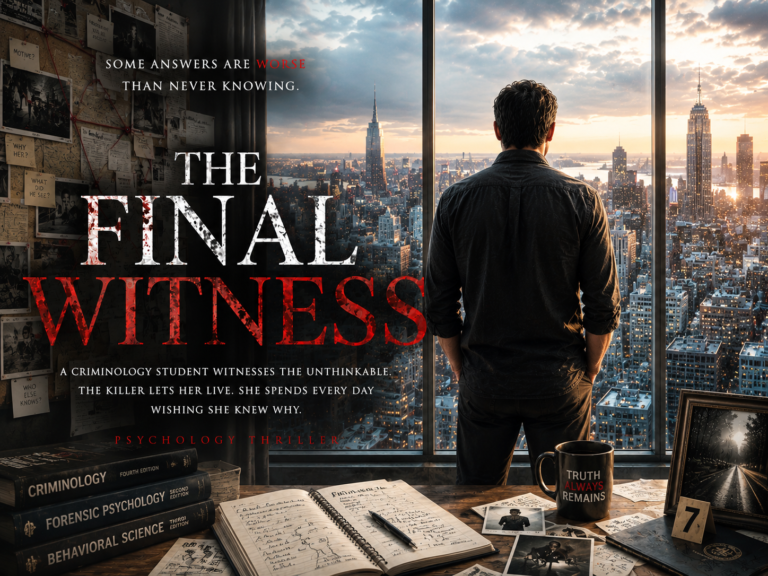
Novel Title: THE FINAL WITNESS
Genre: Psychological Thriller
Author: PARK JIAN (ME)
CHAPTER
THREE
The Wrong Decision
She found it.
I knew she would. I gave her three days in my head — three days before she connected the witnesses. She did it in one night.
I sat at my desk in the dark and stared at my phone and felt something I had not felt in eleven years.
I had underestimated someone.
My Apartment / Early Morning
I opened my notebook to her page.
Under her name I had been writing everything. Small things. The way she walked — fast, head down, always watching her feet like she was counting steps. The way she held her pen when she wrote — tight, like the words might escape if she let go. The way she had looked at me in that hallway.
Not scared.
Memorizing.
I picked up my pen and wrote one line under everything else.
She found the pattern. One night. One night.
I stared at it.
Then I wrote underneath —
She is going to be a problem.
I already knew that. I had known it since the coffee shop. But writing it down made it real in a way thinking it did not.
I closed the notebook.
I needed to make a decision.
Street Near Her Building / Morning
I watched her leave for class at seven fifty three.
She was wearing the same jacket. Notebook in her pocket, corner sticking out. She walked fast, head down, and the officer they had placed outside her building was awake this time — standing properly, coffee in hand, watching the street.
She did not look at him when she passed.
She looked at the street. Both directions. Slow and careful.
She is checking, I realized. She already knows I watch her. She is trying to catch me doing it.
I stepped back behind the corner.
For the first time in eleven years, I smiled.
It was not a warm smile. It was the kind that comes when a problem becomes interesting instead of just complicated.
I followed her at a distance — enough that she would not see me, close enough that I could.
University Campus / 8:15 AM
She stopped outside the criminology building and pulled out her phone.
I stopped too, half a block back, and watched.
She was not calling anyone. She was reading something — scrolling fast, the way you scroll when you are looking for one specific thing. Then she stopped scrolling. Stared at the screen. Put the phone away.
She went inside.
I stood on the pavement and thought about what she could have found.
Then I took out my own phone and started searching the same things she would have searched.
It took me four minutes to find the article.
A journalist — small publication, nobody important — had connected three of the cases six months ago. Bad theory, wrong conclusion, but some of the details were accurate. If Luvena had found that article and put it together with what she already knew—
I put my phone away.
She knew more than the police did.
That was a problem.
That was also — and I did not examine this too closely — impressive.
Coffee Shop on Mercer Street / Afternoon
I was there when she came in.
Same window table. Same drink she would not finish. She pulled out her notebook before she even sat down properly and opened it to a page near the middle.
I was at the counter again. Back to her.
This time I stayed longer.
I listened to the sounds of the room — the coffee machine, the music too low to make out, the rain starting on the window — and underneath all of it, the quiet scratch of her pen moving fast across paper.
She wrote for twenty minutes without stopping.
Then she stopped.
I heard her chair move slightly.
Luvena: “You can turn around. I already know you are there.”
I did not move for a moment.
Then I turned around.
She was looking straight at me. Both hands flat on the table. Notebook closed. Expression completely steady — not calm, I could see the effort it was taking — but steady.
I crossed the room and sat down across from her.
We looked at each other for a long moment.
Luvena: “You left a note on my door.”
Me: “Yes.”
Luvena: “You called my phone.”
Me: “Yes.”
Luvena: “You have been following me since the night we met.”
Me: “Yes.”
She nodded slowly. Like I was confirming things she had already written down.
Luvena: “Why haven’t you killed me?”
I looked at her. Because I do not know yet, I thought. Because something about you does not fit and I need to understand what it is before I decide anything.
Me: “Because you interest me.”
Luvena: “That is not a reason.”
Me: “It is the only one I have right now.”
She looked at me for a long moment. Then she opened her notebook, turned it around, and pushed it across the table toward me.
I looked down.
She had written the names of all six witnesses. Under each name — the connection. No father. No record. No name anywhere.
Under all six names, she had written one question.
Why these people specifically?
And under that, in smaller writing —
Why me?
I looked up from the notebook.
Her eyes were on my face, reading it the way I read hers — fast, careful, looking for the thing underneath the surface.
Me: “You should not have written that down.”
Luvena: “Why?”
Me: “Because now it exists somewhere other than your head. That makes it dangerous.”
Luvena: “You make it dangerous.”
I said nothing.
Luvena: “I want to know why. Those people — why them? Why me?” Her voice was steady but I could hear the thing underneath it. Not fear. Something older than fear. “What are you looking for?”
I looked at her for a long moment.
Then I stood up.
Me: “Stop. Go home. Burn that notebook.”
Luvena: “You know I won’t.”
Me: “I know.” I picked up my coffee. “That is the problem.”
I left before she could say anything else.
I sat on a bench in the rain and did not move for a long time.
In eleven years I had never sat across from a witness. Never spoken to one, not directly, not like that. Never let one see my face in daylight, in a public place, clearly enough to describe every detail.
I had just done all three.
I pressed my hands flat on my knees and breathed slowly.
Why?
I did not have a clean answer. That was the thing that bothered me most — I always had a clean answer. For everything. Every decision I had ever made in eleven years had a reason I could write down in two sentences or less. Clear. Logical. No loose edges.
This had no clean answer.
Just her face across the table. Just those eyes reading mine like she had been doing it her whole life. Just that question — what are you looking for — sitting in my chest like something I had swallowed wrong.
I opened my notebook.
Turned to her page.
Wrote one line.
She asked the right question.
Then underneath it, slower —
She is the answer to the right question.
I stared at what I had written.
For the first time in eleven years, my hand was not completely steady.
My Apartment / Night
I pulled out the box from under the bed.
I had not opened it in four years. Maybe five. I did not keep track because keeping track meant thinking about it and thinking about it meant feeling something and feeling something was not something I allowed myself.
But tonight I opened it.
Inside — old papers. A photograph, faded at the edges. A letter I had written once and never sent. A name on a piece of paper in someone else’s handwriting.
I picked up the photograph.
A woman. Young. Dark hair. Dark eyes.
I looked at it for a long time.
Then I put it face down on the desk without looking at it again.
I picked up the piece of paper with the name on it.
Read it once.
Luvena.
The name had been written on this paper long before she walked into that hallway. Long before I ever saw her face.
I had known this name for years.
I had been looking for her for years.
And now she was sitting across tables from me in coffee shops, asking me the right questions, and I was letting her — I was sitting down and letting her — because something in me that I had buried eleven years ago had recognized her face in a dark hallway and decided, without asking the rest of me, that she was not someone I could walk away from.
I put the paper back in the box.
Closed the lid.
Sat in the dark for a long time.
She was going to find the truth. I knew that now. She was too sharp, too stubborn, too relentless to stop. She was going to pull every thread until the whole thing unraveled and the answer fell out into her hands.
And when it did—
I pressed my eyes shut.
When it did, I would lose the only thing I had been protecting for eleven years.
Her……..
The Things He Did Not Say
I sat in that coffee shop for a long time after he left.
My notebook was still open on the table. His coffee cup was still there — he had not finished it. I stared at it like it was evidence, which I suppose it was.
He had sat across from me.
He had answered every question I asked.
And somehow that was more frightening than if he had said nothing at all.
Coffee Shop on Mercer Street — Continued
I picked up my pen.
At the bottom of the page, under everything else, I wrote —
He is not what I expected.
I stared at that line for a long time.
Then I crossed it out.
Then I wrote it again.
Because it was true and crossing it out did not make it less true. I had expected cold. I had expected threatening. I had expected the kind of person you see in documentaries — distant, robotic, impossible to read.
He was cold. He was impossible to read.
But he had sat down.
That was the thing I could not get past. He had sat down across from me like it was a normal thing to do, like we were two ordinary people having a conversation, and he had answered my questions in that flat, calm voice and looked at me the whole time like he was trying to figure something out.
You interest me, he had said.
I did not write that down. Some things feel too strange to put in writing.
I closed my notebook, picked up my bag, and left.
Detective Callum’s Office — Afternoon
Detective Callum: “Sit down.”
Luvena: “I need to tell you something.”
Detective Callum: “Sit down first.”
I sat. He closed the door. Pulled his chair around so he was not behind the desk — just two people in a small room, which I understood was intentional.
Detective Callum: “You look like you have not slept in three days.”
Luvena: “Two. What did you find? On the other witnesses?”
He looked at me for a moment. Then he opened a folder on his desk and turned it toward me.
Six names. Six faces. Photographs clipped to the corner of each page.
Detective Callum: “All alive. All in different cities now. We have been trying to reach them — three picked up, three did not.” He tapped the folder. “The three who picked up all said the same thing. He looked at them and walked away. No explanation. No contact after.”
Luvena: “He contacted me.”
Callum went very still.
Detective Callum: “When.”
Luvena: “Phone call. Two nights ago. And a note on my door.” I reached into my notebook and pulled out the folded paper. Slid it across the desk.
He picked it up. Read it. His jaw tightened.
Detective Callum: “Why did you not tell me immediately?”
Luvena: “Because I was thinking.”
Detective Callum: “Luvena—”
Luvena: “He also came to the coffee shop this morning. He sat across from me.” I kept my voice steady. “We talked.”
Callum put the paper down very carefully. The kind of careful that means a person is controlling something.
Detective Callum: “You talked.”
Luvena: “Yes.”
Detective Callum: “To the man who has killed at least four people.”
Luvena: “Yes.”
Detective Callum: “In a public coffee shop.”
Luvena: “The officer outside my building was looking at his phone. I did not think telling him would help.”
Callum pressed two fingers to his forehead and was quiet for a moment.
Detective Callum: “What did he say?”
Luvena: “He told me to stop investigating. Burn my notebook.” I paused. “He answered my questions.”
Detective Callum: “What questions?”
Luvena: “I showed him the connection between the witnesses. All of us — no father listed. No record. Nothing.” I looked at him directly. “He did not deny it meant something.”
Callum looked at me for a long time.
Detective Callum: “Luvena. I need you to understand something. This man is extremely dangerous. Whatever he said to you, whatever he seemed like — that is not real. People like this are very good at seeming like something they are not.”
Luvena: “I know that.”
Detective Callum: “Do you?”
I looked at the six photographs on his desk.
Luvena: “Why these six people? That is the question nobody has answered yet. Not you, not the investigation, nobody. There is a reason he picks specific witnesses. A very specific reason. And until we know what it is—” I stopped. Looked up. “I think I am the one he was actually looking for. I think the others were — practice. Or searching. I think I am the one he wanted to find.”
The room was very quiet.
Detective Callum: “Why do you think that?”
Luvena: “Because he did not seem surprised to see me. Not even for a second.”
University Library / Evening
I found the article at seven PM.
Small publication. Bad writing. But three paragraphs in, something made me stop.
A quote from an anonymous source — someone who claimed to know the killer’s history, who had spoken to the journalist once and then disappeared. The quote was short.
“He is not looking for victims. He is looking for one specific person. The victims are how he funds the search. The witnesses are how he narrows it down.”
I read it four times.
The witnesses are how he narrows it down.
I sat back in my chair.
All six of us. No father. No record. He was not leaving witnesses alive out of mercy or habit or some psychological compulsion.
He was running a search.
And I was the result.
My phone buzzed on the table.
Unknown number.
I picked up immediately.
Luvena: “What are you looking for?”
A pause. Then —
Him: “You already know.”
Luvena: “Tell me anyway.”
Him: “Not yet.”
Luvena: “Why not?”
Him: “Because you are not ready.”
I gripped the phone harder. “That is not your decision—”
Him: “You went to the police.”
It was not a question. Not angry. Just flat. Observing.
Luvena: “Yes.”
Him: “I expected that.”
Luvena: “Then why call?”
Silence for a moment. Long enough that I thought he had gone.
Then —
Him: “To tell you to stop looking at that article.”
My blood went cold.
Luvena: “How do you know what I am reading?”
He did not answer that.
Him: “The source in that article is dead. Whatever they told that journalist was incomplete. It will lead you somewhere wrong.”
Luvena: “Then lead me somewhere right.”
Another silence.
Him: “Go home, Luvena.”
The line went dead.
I sat in the library surrounded by books and quiet and the low hum of the lights and I realized my hand was shaking — not from fear this time.
From anger.
He knew my name. He knew where I was. He knew what I was reading in real time.
And he was still — after everything — trying to protect me from something.
Why?
My Apartment / Late Night
I could not sleep again.
I sat at my desk with every piece of paper I had spread out in front of me. Names. Dates. Locations. The photographs Callum had shown me. The article. My own notes going back to the first night.
I stared at all of it for a long time.
Then I picked up the photograph Callum had given me — a copy of the only CCTV image they had of the killer, grainy, taken from a distance, mostly shadow.
I looked at it for a long time.
There was something about the way he stood. Something familiar that I could not name, that kept sliding away every time I tried to hold onto it. Like a word you know but cannot say out loud.
I put the photograph down.
Opened my notebook to a clean page.
Wrote at the top — What do I actually know about him?
And then I stopped.
Because the honest answer, the one I had been avoiding writing down since the coffee shop, sat at the back of my mind and would not move.
He had looked at me across that table like he already knew me.
Not like a target. Not like a witness. Not like a problem to solve.
Like someone he had been waiting a long time to sit across from.
And the most frightening thing — the thing I had not told Callum, the thing I had not written in my notebook until right now, at midnight, alone in my apartment — was that I had felt it too.
That strange, heavy, impossible feeling of looking at a stranger and thinking —
I know you from somewhere.
I pressed my pen to the paper.
Wrote one line.
He is looking for me. He has been looking for me for a long time. And I think — on some level I cannot explain yet — I have been looking for him too.
I stared at what I had written.
Then I turned the page over so I could not see it.
Some truths are too big to look at directly.
Everything I Built
I made a mistake.
Not the kind I could fix in forty seconds like a lock on a door. The kind that sits in your chest and gets heavier every time you breathe.
I had called her again.
I had told myself it was practical — she was reading the wrong article, going in the wrong direction, and a wrong direction meant more questions and more questions meant more danger for both of us. That was the reason. That was the only reason.
I sat in my apartment in the dark and knew I was lying to myself.
That was new. I had not lied to myself in eleven years.
My Apartment — Early Morning
I opened the box again.
I did not plan to. My hands just — went there, under the bed, pulled it out, opened it before my mind caught up.
The photograph was face down where I had left it.
I turned it over.
Dark hair. Dark eyes. Young — she had been so young in this photo, younger than Luvena was now. Smiling at something outside the frame, something I could not see, something that had made her look like the whole world was a simple and good place.
She had believed that. Right until the end, she had believed that.
I put the photograph down.
Picked up the letter I had never sent.
I had written it the night I made my decision — the decision that started everything, the one I had spent eleven years telling myself was right. The letter was an explanation. An apology dressed up as an explanation. Three pages, front and back, every word chosen carefully.
I had never sent it because there was nobody left to send it to.
I folded it back up. Put it away.
Picked up the piece of paper with Luvena’s name on it.
Her name — written in someone else’s handwriting. Not mine. Hers. The woman in the photograph. Written on a piece of paper that had been left for me to find, years ago, with two lines underneath it.
Her name is Luvena. Find her when it is time.
I had been waiting for the right time for four years.
I had never decided what right time meant.
Until a girl walked into a dark hallway and did not run.
Street Outside Police Station — Morning
Callum left the building at eight forty.
I watched him cross the street, coffee in hand, phone to his ear, moving fast. He was good — I had been watching him for two days and he was genuinely good at his job. Careful. Sharp. The kind of detective who pulled threads slowly instead of yanking and breaking them.
He was also getting too close.
Not to me — not yet. But to the pattern. To the why behind the witnesses. If he pulled that thread far enough, he would not find me at the end of it.
He would find her.
And Luvena finding out the truth from a police detective in a grey office with a folder on the desk and photographs on the wall was not — I stopped myself.
Why does it matter how she finds out?
I did not have a clean answer.
I walked away from the police station before Callum came back outside.
Park Bench — Midday
I sat with my notebook open on my knee and did not write anything for a long time.
A woman walked past with a small child — the child was pointing at pigeons, excited, saying something too fast to be understood properly. The woman was laughing. Ordinary. Completely ordinary.
I watched them go.
I tried to remember the last time something ordinary had felt like it belonged to me.
I could not.
I looked down at my notebook.
Turned to Luvena’s page.
Under everything I had already written, I added —
She said she had been looking for him too. She does not know what she meant by that yet. She will.
I stared at those lines.
Then I wrote —
What happens after she knows?
I had never written that question before. I had never let myself get close enough to it to write it down.
Because the answer — the honest answer — was one I could not control.
And I controlled everything. That was the point. That was the whole structure of eleven years. Control. Precision. No loose edges.
Luvena was nothing but loose edges.
And I had sat down across from her in a coffee shop and answered her questions.
I pressed the pen flat against the page.
What happens after she knows?
I knew what happened. I had always known.
She would grieve. Then she would hate me. Then — if she was lucky, if she had enough left in her after all of it — she would try to move forward with an answer she never wanted.
And I would be gone before any of that happened.
That was the plan. That had always been the plan.
I closed the notebook.
Abandoned Building / Afternoon
I had a meeting.
The man I was meeting was not someone I liked. He was someone I used, which was different. He found information I could not access on my own — the kind that lived in places money and patience could not reach alone. He had been useful for six years. He asked no questions because I paid him enough not to.
He was already there when I arrived, sitting on a broken chair in the empty first floor, eating something from a paper bag.
Him: “You are late.”
Me: “You have something for me.”
He put the bag down. Reached into his coat. Pulled out a folded paper and held it out.
I took it. Opened it.
A name. An address. A date.
Me: “This is everything?”
Him: “That is everything there is. Whoever buried this did a very good job. It took me four months.” He looked at me with the flat eyes of a man who had stopped being curious about other people’s business a long time ago. “You want to tell me what this is about?”
Me: “No.”
Him: “The girl — the witness. The one the police have. She is connected to this?”
I looked at him.
He raised both hands. “Not my business. I know. I am just saying — there is a detective named Callum who is very good and he is moving faster than you think. If he gets to that address before you do—”
Me: “He won’t.”
Him: “You sound very sure.”
Me: “I am always sure.”
He picked up his bag again. “There is one more thing. The source from that article — the anonymous one. You told the girl they were dead.”
I said nothing.
Him: “They are not dead.”
I went completely still.
Him: “Whoever told you they were — lied to you. The source is alive. And they have been talking to Callum’s team for the last forty eight hours.”
The room was very quiet.
Me: “Where.”
He told me.
I left without saying anything else.
Hotel on the East Side — Evening
The source was a woman in her sixties. Small room, third floor, curtains drawn. She opened the door with the chain still on and looked at me through the gap with eyes that recognized me immediately.
Her: “I wondered when you would come.”
Me: “You told them you were dead.”
Her: “I told you I would disappear. I did not specify how.” She studied me through the gap. “You look exactly like her, you know. Around the eyes.”
Something in my chest went very tight.
Me: “Open the door.”
Her: “Will you hurt me?”
I looked at her for a long moment. She was afraid. She was also — I could see it — the kind of person who had made peace with being afraid a long time ago and learned to function inside it.
Me: “No.”
She took the chain off.
Inside, she had papers spread on the small table — old ones, the kind that curl at the edges from being folded and unfolded too many times. She sat on the edge of the bed and folded her hands and looked at me like she was waiting for a question she already knew.
Me: “What did you tell them.”
Her: “Not enough to find you. Enough to find her.”
Me: “Luvena.”
Her: “She deserves to know.” Her voice was quiet but firm. “I kept this secret for twenty years because she asked me to. Because she thought it was the right thing — protecting you, protecting Luvena, keeping everyone separate and safe.” She looked at me steadily. “But she is gone now. And you are still here. And that girl is sitting alone in an apartment trying to understand why a killer keeps calling her phone instead of hurting her.” She paused. “How long are you going to make her search for something you could just tell her?”
I stood in the middle of the small room and said nothing.
Her: “She was three months old when you left. Did you know that? Three months. She had just started to recognize faces.” Her voice did not break. She had clearly said this to herself enough times that she had worn the emotion out of it. “She used to reach for strangers in the street who had dark hair. Her mother thought it was just — babies, you know, the way they are. But I always thought—” She stopped. “I always thought she was looking.”
The room felt very small.
Me: “What did you tell Callum’s team.”
Her: “That the witnesses were not random. That there was a pattern and it led to one specific person.” She met my eyes. “I did not give them your description. I did not give them your history. I gave them enough to protect her. That is all.”
I looked at her for a long moment.
Then I picked up my coat.
Her: “You are going to her.”
I did not answer.
Her: “Tell her yourself. Do not let her find out from a police report in a grey office. She deserves better than that.”
I stopped at the door.
Me: “I know.”
I said it so quietly I was not sure she heard it.
I left.
Outside Luvena’s Building / Night
I stood on the pavement across the street and looked up at her window.
The light was on.
She was awake. She was always awake — I had noticed that in eleven days of watching, she barely slept, she stayed up with her notebook and her papers and her relentless, exhausting need to understand everything.
She got that from me.
I pressed my hand flat against the wall beside me and breathed slowly.
Inside that building was a girl who had grown up without a father, who had lost her mother three years ago, who was now alone in the world running toward a truth that was going to destroy the small fragile structure she had built to survive in.
And I was the truth.
I was the thing she had been running toward without knowing it.
And tomorrow — or the day after, or whenever Callum’s team put the last piece together — she was going to find out.
The only question left was whether she heard it from me first.
I looked up at her window for a long time.
The light stayed on.
So did I.
Was he standing outside her building to protect her — or to finally say the one thing he had never let himself say in twenty years?
The Last Page
I woke up at four in the morning and knew something was different.
Not dangerous. Just — different. The way the air in a room changes when someone has been standing in it.
I sat up. Looked at my window.
Nothing.
I looked at my door.
Nothing.
But I could not go back to sleep. So I made tea I did not drink and sat at my desk and opened my notebook and stared at the last line I had written two nights ago — the one I had turned face down because it was too large to look at directly.
I think I have been looking for him too.
I read it for a long time.
Then I picked up my pen and wrote underneath it —
I think tomorrow I find out why.
My Apartment — 7:00 AM
The knock came at seven exactly.
Not the door — the window. Third floor. I lived on the third floor.
I crossed the room slowly and looked through the glass.
He was standing on the fire escape.
Not threatening. Not holding anything. Just standing there in the early morning light with his hands at his sides, and when I looked at his face — really looked, in daylight, without fear making everything blurry — something happened in my chest that I did not have a name for.
I opened the window.
Luvena: “You could have used the door.”
Him: “The officer is downstairs.”
Luvena: “So you climbed the fire escape.”
Him: “Yes.”
I stepped back. He climbed through. Stood in my apartment — this small ordinary room with my books and my mother’s rug and her photograph on the shelf — and looked around like he was seeing something he had imagined many times and was now checking it against the real thing.
Luvena: “Sit down.”
He sat. I sat across from him. We looked at each other.
Luvena: “Tell me.”
My Apartment / Continued
He was quiet for a long moment. Long enough that I thought he was going to stand up and leave again, the way he always left — just gone, before I could catch the edge of whatever he was actually trying to say.
But he did not leave.
He reached into his coat and put something on the table between us.
A photograph. Old. Faded at the edges.
I picked it up.
A young woman. Dark hair. Dark eyes. Smiling at something outside the frame.
My hands went very still.
Because I knew that face.
Not from a photograph — from a mirror. From every morning of my life, looking at my own reflection and seeing something I could never quite place.
Luvena: “Who is this.”
Him: “Her name was Mara.” His voice was completely flat. The flattest I had ever heard it. “She was twenty three in that photograph.”
Luvena: “Was.”
Him: “She died three years ago.”
Three years ago. My mother had died three years ago.
The room felt like it was tilting.
Luvena: “That is my mother.”
Him: “Yes.”
One word. Just one word, and everything I had built — every theory, every notebook page, every carefully constructed wall between what I suspected and what I would allow myself to believe — came apart all at once, quietly, the way old things fall apart. Not dramatic. Just done.
Luvena: “You knew her.”
Him: “Yes.”
Luvena: “How.”
He looked at the photograph in my hands.
Him: “We were young. We made choices that seemed right at the time.” He paused. “She left. She said it was the only way to keep you safe. Safe from — what I was becoming. What I had already become.” His voice did not change. That was somehow the worst part. “She was right. I was not — I was not someone who should have been near a child. Near anyone.”
I could not speak.
Him: “She left me a letter. When she died. It took four years to reach me — she had planned it that way. Inside the letter was your name and two lines.” He reached into his coat again. Put a piece of paper on the table.
I picked it up with hands that were not steady anymore.
Her name is Luvena. Find her when it is time.
My mother’s handwriting.
I had seen that handwriting every day of my life — on birthday cards, on grocery lists, on little notes she used to leave on my pillow when I was small. Sleep well, little beloved one. That was what she always wrote. Sleep well.
Luvena: “She knew.” My voice came out strange. Too quiet. “She knew what you were. What you had done. And she still — she still told you to find me.”
Him: “I think she believed that finding you might—” He stopped. “I do not know what she believed. I only know what she wrote.”
I put the paper down.
I looked at the man sitting across my table.
The man who had killed at least four people. The man who had been watching me for eleven days. The man who had called my phone and left notes on my door and climbed my fire escape at seven in the morning.
The man who had spent four years looking for me because my mother had asked him to.
Luvena: “Why did you leave witnesses alive. All those years. All those people with no father listed. You were looking for me.”
Him: “Yes.”
Luvena: “That is why they were chosen. Not the victims — the witnesses. You were choosing the witnesses.”
Him: “I was searching. I did not know where you were. I did not have much — just that you had no father listed anywhere. That you were alone. That was all she told me before she—” He stopped. “Before I lost contact with her.”
Luvena: “So you left a witness at every scene. Someone like me. To narrow it down.” My voice was shaking now. I could hear it. I could not stop it. “And those witnesses — the ones who were not me — what happened to them? They just — went home? Went back to their lives?”
Him: “Yes.”
Luvena: “Dana did not go home.”
The room went very quiet.
He said nothing.
Luvena: “Dana is dead. My roommate. The woman whose home I was sharing. She is dead because you were looking for me and you went to the wrong apartment and she was there.” My voice broke on the last word, just slightly, and I pressed my hands flat on the table. “She kept a photo of her mother on her fridge. She left her kitchen light on at night because she was scared of the dark.”
He looked at me.
Luvena: “She did not deserve that. None of them deserved any of it.”
Him: “No.” It was barely a word. Just a sound. “They did not.”
Luvena: “And you—” I stopped. Breathed. Started again. “You are my father.”
He did not say yes. He did not say no. He just sat there and looked at me like the word had hit somewhere that still had feeling in it.
That was answer enough.
My Apartment — 8:30 AM
I stood at the window with my back to him for a long time.
Outside, the city was waking up. Ordinary sounds — a bus, someone’s radio, a dog barking two streets over. The officer downstairs shifted his weight, glanced at his phone, looked away.
Everything ordinary. Everything exactly the same as yesterday.
Except nothing was the same. Nothing would ever be the same again.
Luvena: “I used to ask my mother about my father. When I was small.” I did not turn around. “She always changed the subject. Always. And one day I just — stopped asking. Because I could see that it hurt her. And I loved her more than I needed an answer.”
He said nothing behind me.
Luvena: “I spent my whole life with a question I was not allowed to ask. And then she died and I could not ask her anything anymore and I thought—” My voice cracked. I pressed my hand against the window glass. Cold. “I thought that was it. That I would just — never know. That some questions do not get answers.”
Him: “Luvena—”
Luvena: “Do not.” I turned around. “Do not say my name like that. Like you have been saying it for years. Like it belongs in your mouth.”
He closed it.
Luvena: “I found you. Or you found me. And now I know.” I looked at him directly. “And I want you to leave.”
Something moved in his face. There and gone.
Him: “Callum’s team—”
Luvena: “I know. They are coming.” I crossed to my desk. Picked up my phone. “I called them this morning. Before you knocked on my window.”
He went still.
Luvena: “I knew you were going to come today. I do not know how I knew. I just did.” I looked at him. “I wanted to hear it from you first. Not from a report. Not from Callum in a grey office.” My voice was steady now, steadier than I expected. “I wanted to look at you and hear you say it.”
Him: “And now?”
Luvena: “And now I need you to go.”
He stood. Slowly. He picked up the photograph from the table and held it out to me.
I took it.
He crossed to the window. Put his hand on the frame.
Luvena: “She asked you to find me.” I looked at the photograph in my hands. “Why? What did she want you to do when you found me?”
He was quiet for a long moment.
Him: “I think—” He stopped. Started again. “I think she just wanted you to know you were not alone in the world. That somewhere there was someone who was — yours. Even if that someone was—” He did not finish the sentence.
I looked up.
For one second — just one — he looked like a person instead of what he was. Tired. Old in a way that had nothing to do with age. Carrying something he had been carrying so long he had forgotten what it felt like to put it down.
Then it was gone.
Him: “I am sorry. For all of it.”
He climbed out the window.
He did not look back.
I stood in the middle of my room and listened to his footsteps on the fire escape going down, getting quieter, and then nothing.
Gone.
Police Station / Later That Morning
Detective Callum: “Are you sure about this?”
Luvena: “Yes.”
He looked at me for a long moment. Then he slid the paper across the desk.
The address. The location his team had traced. Everything they needed.
I had given it to them.
Detective Callum: “You could have called this in last night.”
Luvena: “I know.”
Detective Callum: “You waited until after he came to you.”
Luvena: “Yes.”
He studied my face. “Did he hurt you?”
Luvena: “No.”
Detective Callum: “Did he threaten you?”
Luvena: “No.”
Detective Callum: “Luvena. What did he say to you?”
I looked at the desk between us. At the folder with six photographs. At all those ordinary faces — six people who had gone home when she had not. Six people who had been searched and discarded. Six people who had never known what they were part of.
Luvena: “He said he was sorry.”
Callum was quiet for a moment.
Detective Callum: “That’s all?”
I looked up.
Luvena: “That’s all.”
My Apartment — Night
They found him at noon.
Callum called to tell me. His voice was careful, professional, the way it always was when he was managing something emotional inside himself.
He did not resist. That was what Callum said. They found him at the address and he was sitting at a desk in an empty apartment and he did not resist.
I sat on my bed and held my phone for a long time after the call ended.
Then I picked up my notebook.
Opened it to the very first page — the one I had written on the night it all started, sitting on my bed with my back against the wall, staring at the door.
I read through everything. Every page. Every name. Every question.
At the very end, on the last written page, I added one line.
The killer always leaves one witness alive.
I stared at it.
Then underneath, slowly —
I was never just a witness. I was the reason.
I closed the notebook.
Put it on the shelf next to my mother’s photograph.
Looked at her face for a long time — that young woman smiling at something outside the frame, something I would never see, something that had made her look like the world was simple and good.
You should have told me, I thought. You should have just told me.
But I understood why she had not. I understood it the way you understand things that hurt — not completely, not without anger, but enough. She had loved me the only way she knew how, which was to keep me far from the thing she was afraid of. And she had loved him too — enough to ask him to find me when she was gone. Enough to believe that somewhere under everything he had become, there was still something worth knowing.
I did not know if she was right about that.
I did not know if I would ever know.
I turned off the light.
Lay down in the dark.
And for the first time in eleven days — I slept.
EPILOGUE
Six Months Later
The trial lasted three weeks.
I sat in the back of the courtroom every day. Not because anyone asked me to. Not because Callum thought it was a good idea — he did not. But because I needed to see it through to the end. That was who I was. I had always been someone who needed to see things through.
He never looked at me during the trial. Not once. I noticed that.
I noticed everything. I always had.
On the last day, when the verdict came and the room filled with sound, I sat very still in my seat and looked at the back of his head and thought about my mother’s handwriting on a piece of paper.
Find her when it is time.
I thought about a girl reaching for strangers with dark hair in the street.
I thought about eleven days of phone calls and notes and a fire escape at seven in the morning and one photograph placed on a table between two people who did not know how to be what they were to each other.
I thought about Dana’s kitchen light.
I thought about six people who went home and one who did not.
I stood up when everyone else stood. Filed out with the crowd. Stepped into the daylight outside the courthouse and stood on the steps and breathed the cold air and let it hit my face.
Callum appeared beside me.
Detective Callum: “How are you doing.”
Luvena: “I don’t know yet.”
Detective Callum: “That’s honest.”
Luvena: “I’m working on honest.”
He was quiet for a moment. Then —
Detective Callum: “What will you do now?”
I looked at the street. The ordinary city. The buses and the people and the noise of everything continuing, the way it always did, indifferent and loud.
Luvena: “Finish my degree. Figure out the rest.”
Detective Callum: “Criminology.”
Luvena: “Criminology.”
He almost smiled. “Of course.”
I put my hands in my jacket pockets and felt the worn corner of my notebook against my fingers.
I had started a new one — blank pages, clean cover, bought from a shop on Fifth Street the week after everything ended. But the old one was still there. I had not been able to leave it behind.
Some things you carry. Not because they are light. Because they are yours.
I walked down the courthouse steps into the ordinary afternoon.
I did not look back.
“The killer always leaves one witness alive.”
She finally understood why.
She was the last page of a story he had been writing for twenty years ……. and the first page of one she was only just beginning.
“Thank you for staying until the end.”
Author Note
This one was hard to write.
Not because of the plot or the words. But because of Luvena. A girl who grew up with one missing piece and spent her whole life pretending it did not hurt. I think a lot of us know what that feels like.
I did not want to give her an easy ending. Easy endings are comfortable but they are not always honest. So I gave her something harder and more real — an answer that cost something. The kind of answer that does not fix everything but at least lets you sleep at night.
If this story made you feel heavy, good. It was supposed to.
If you stayed until the last line … thank you. Genuinely.
You were the witness I was writing for.
With love, AUTHOR 🖤